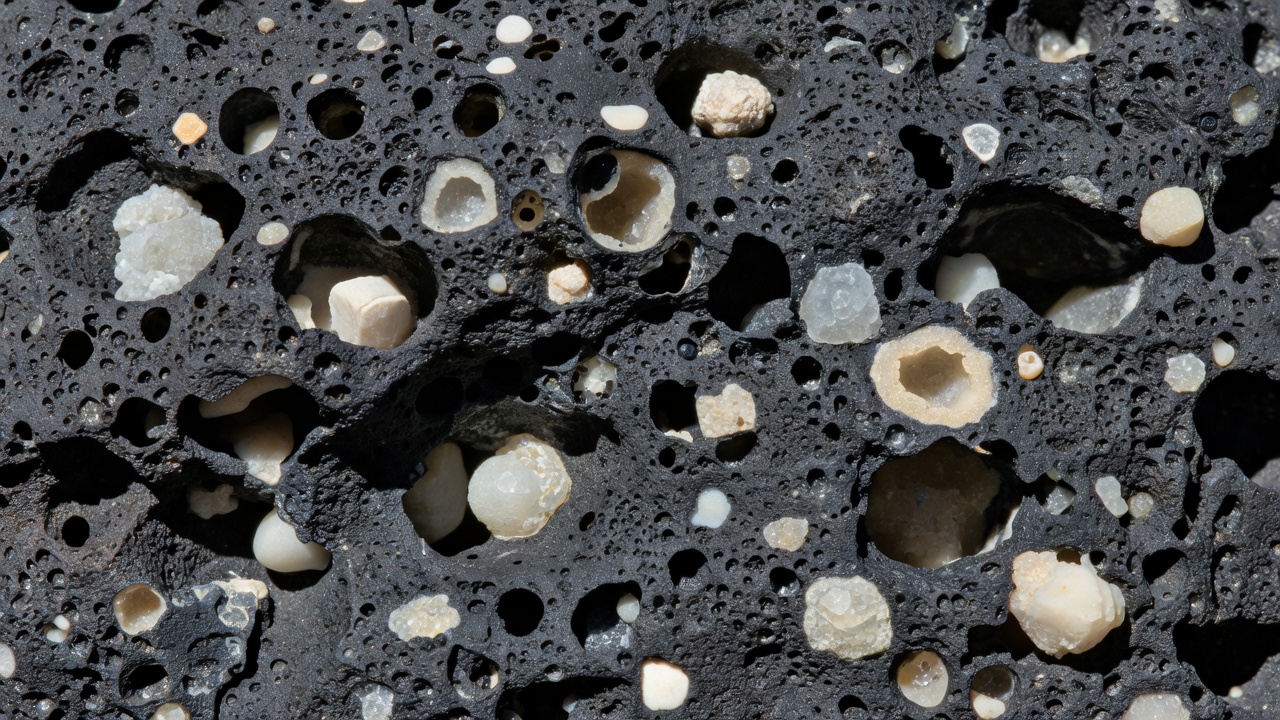
A specimen does not need to be large to preserve a sequence of events. A vein cutting a rock is generally younger than the rock it cuts. A crystal coating an exposed cavity wall formed after that surface became available. These relationships provide relative timing, even when no numerical age is known. They are more dependable than a story built from color alone.
Read the cooling texture
Igneous rocks form as molten material solidifies, but the path from melt to solid varies. Rapid cooling can produce very fine grains or glass, while slower cooling commonly allows larger crystals to develop. This is a useful pattern, not a universal stopwatch: composition, water content, nucleation and changing conditions also influence texture.
Basalt commonly has a fine-grained groundmass, sometimes containing larger crystals that began growing before eruption. Granite typically contains visible interlocking grains formed at depth. Obsidian is volcanic glass, not a single mineral species, because it lacks the long-range ordered structure required of a crystalline mineral. Pumice records abundant gas bubbles within a rapidly cooled volcanic material.
Columnar joints at the Giant's Causeway in Northern Ireland are fractures associated with cooling and contraction of basaltic lava. The columns are not giant mineral crystals. The distinction matters: repeated geometric shapes can arise from physical cracking as well as crystal growth. Similar-looking outlines need not record the same process.
Follow fluids through available space
Hot or cool water moving through rock can transport dissolved components. When temperature, pressure or chemistry changes, minerals may precipitate in fractures and cavities. A quartz vein therefore need not represent molten quartz injected into a crack. The visible vein may instead record mineral deposition from fluids over more than one episode.
In volcanic rocks, gas bubbles can leave vesicles. Later fluids may line or fill those spaces, producing mineral-filled cavities called amygdales. A geode is a hollow, commonly rounded body with a mineral-lined interior; not every geode begins as a volcanic bubble. Sedimentary settings also produce geodes, so the host and locality remain important evidence.
Amethyst-bearing volcanic provinces in Brazil and Uruguay illustrate how quartz growth can follow the formation of its host lava. The purple color of amethyst involves iron-related defects and irradiation, not a distinct purple mineral species. Color zoning can be informative, but it does not independently identify a fluid source or reveal an exact growth temperature.
Explain large crystals without a simple clock
Pegmatites are exceptionally coarse-grained rocks, many associated with granitic systems. Their large crystals are not adequately explained by “very slow cooling” alone. Melt composition, volatile components, transport and nucleation behavior can all help crystals grow. Some pegmatites host beryl, tourmaline and other minerals that interest collectors and gemologists.
A large crystal does not prove a long growth duration without further evidence. Equally, a tiny crystal is not necessarily young. Size records the combined effects of growth rate, available material, competing crystals and the time during which conditions remained favorable. Avoid converting an impressive dimension directly into an age estimate.
Mineral associations can narrow the possibilities. Quartz, feldspar and mica together suggest different chemical circumstances from olivine and pyroxene in a dark volcanic rock. Yet a loose crystal separated from its matrix has lost part of that contextual evidence. Preserve accompanying fragments and labels whenever they were collected legally and safely.
Place gemstones within the wider rock cycle
Gemstone is a use and quality category, not one formation mechanism. Ruby and sapphire are varieties of corundum; ruby's red color is associated with chromium. Corundum can occur in metamorphic and igneous-related settings. Emerald is a green variety of beryl whose formation requires appropriate sources and transport of its constituent elements, including its coloring elements.
Most natural gem diamonds formed at mantle depths and were later transported toward the surface by magmas such as kimberlite. They did not simply crystallize in an ordinary surface lava flow. A stone's present sedimentary setting may be even later: weathering and rivers can liberate resistant minerals and concentrate them far from their original source.
Regional context turns a hand-specimen hypothesis into a better geological interpretation. Geological maps, published locality studies and museum records can clarify which rocks occur nearby and how they relate. For broader background, the British Geological Survey and the United States Geological Survey provide educational and technical resources. Their work is not a substitute for a site-specific assessment of collecting hazards.
Build a short formation sequence
List only relationships you can support: host rock first, an open fracture next, mineral coating later. Mark the uncertain steps rather than filling them with an attractive guess.
Further reading: British Geological Survey, United States Geological Survey and Gemological Institute of America. These organizations are independent of this site.
Next: test the mineral name