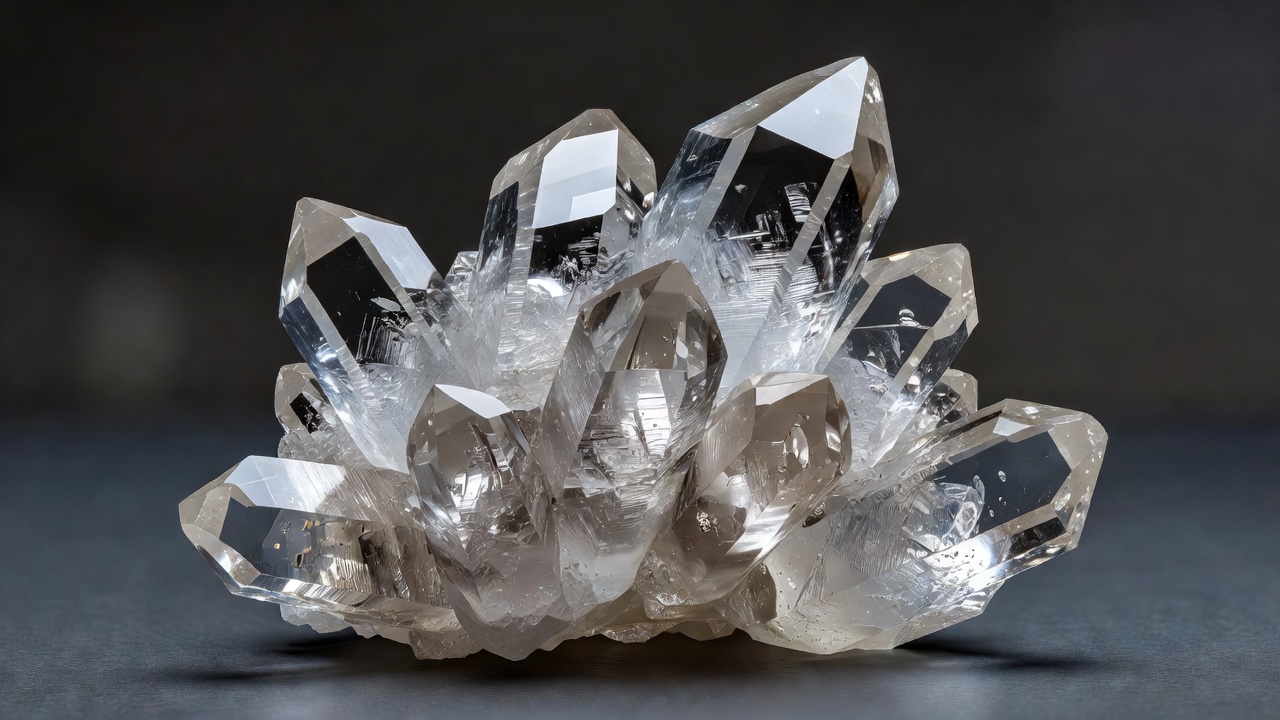
Begin with a single boundary. Is it a smooth, flat growth face, a fresh break or a surface polished by transport? Rotate the specimen under a soft lamp rather than relying on one dramatic photograph. Repeated faces and consistent edges can reveal a structured pattern, while chips and weathering may hide it. Record what you can see without assuming that every reflective plane belongs to the original crystal.
Separate crystal system from crystal habit
A crystal system describes symmetry and the geometric relationships of crystallographic axes. Mineralogy recognizes seven systems: triclinic, monoclinic, orthorhombic, tetragonal, trigonal, hexagonal and cubic. These are not seven specimen shapes. A crystal may belong to one system while showing several outward habits, depending on which faces develop most strongly.
Habit describes the overall appearance: prismatic, tabular, needle-like or fibrous, for example. Quartz belongs to the trigonal system, although a familiar quartz prism commonly presents a six-sided outline. Pyrite belongs to the cubic system but can form cubes, octahedra or pyritohedra. These examples show why counting edges is a starting observation rather than a complete identification method.
Look for growth space and interruptions
Large, well-developed faces usually require room to grow. In a crowded rock, neighboring grains obstruct one another, leaving irregular boundaries even when every grain has an ordered internal structure. A cavity can provide open space, but an exposed crystal may still grow unevenly if nutrients reach one side more readily than another.
Changes in temperature, dissolved components or fluid supply can leave zones, surface steps and interrupted growth. An inclusion is material enclosed during or after a mineral's development; its interpretation depends on its relationship to the host. A visible line inside quartz is not automatically a separate mineral, and an apparent “phantom” outline requires careful lighting before it can be described confidently.
Distinguish faces, cleavage and fracture
Crystal faces form during growth. Cleavage describes a mineral's tendency to break along particular structural planes. Fracture describes breakage that does not follow cleavage. All three can affect a specimen's silhouette. Calcite commonly produces rhombohedral cleavage fragments; those fragments should not automatically be described as complete, naturally grown rhombohedral crystals.
Quartz has no cleavage and commonly displays conchoidal fracture, producing curved, shell-like breaks. Feldspar often shows two prominent cleavage directions that meet at or near a right angle. Existing breaks can be useful evidence, but deliberately breaking a specimen is rarely a sensible first test. Valuable information about growth and mineral associations may be lost in the process.
| Surface | How it develops | Useful caution |
|---|---|---|
| Growth face | Material is added along an ordered boundary. | Damage may remove the original edge. |
| Cleavage plane | The mineral separates along a preferred structural plane. | A fragment may resemble a grown crystal. |
| Fracture | Breakage does not follow a cleavage plane. | Some fractures are locally flat. |
Read clusters without overinterpreting them
Twinning involves two or more crystal individuals joined in a specific crystallographic relationship. A random crossing of crystals is not sufficient evidence. Gypsum can display swallowtail twins, while some feldspars show repeated twinning that is especially useful under appropriate optical examination. A hand specimen may suggest a twin relationship without exposing enough geometry to establish it.
Aggregates need a separate vocabulary. Radiating groups spread outward from a center; drusy coatings consist of many small crystals covering a surface. Botryoidal material has rounded, grape-like masses, often built from much smaller internal units. These descriptions communicate what is visible without claiming a composition. Malachite, hematite and other minerals can all form rounded aggregates.
The giant gypsum crystals of Naica, Mexico, illustrate the importance of sustained geological conditions rather than a mysterious exception to crystallography. Scientific explanations connect their growth with water chemistry and a suitable thermal environment. The caves are hazardous environments, not casual collecting destinations. Their value here is as an example of how a striking form invites testable questions.
Continue the evidence trail
Photograph the whole cluster, sketch one individual and note which surfaces remain uncertain. Then compare the visible geometry with independent properties in our identification guide.
Reference starting points: Mindat for locality and habit records, and the International Mineralogical Association for mineralogical standards and nomenclature. Individual locality reports vary in completeness.
Next: unusual mineral forms